Tuesday, November 22, 2011

Strange Products By Their Nature

Lists of ridiculous products, but they are more about commonly owned popular goods.

Giant Remote


If you keep losing your remote down the side of the sofa then you know there’s only one solution: buy a remote that’s bigger than your children – you never lose them… right? This giant, and apparently extremely basic, remote can also be used as a small coffee table or for attacking burglars. It is cheap as chips too – only $19.95 to own the ugliest piece of technology equipment ever made, iPad notwithstanding.

Jingle Jugs
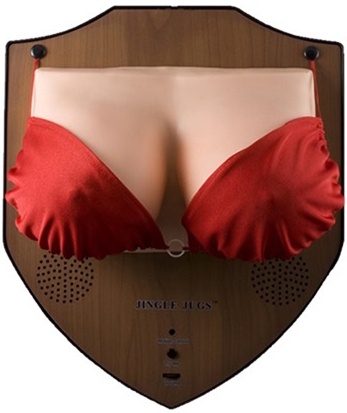

Are you sick of those boring deer heads stuck to your wall? Lucky for you there is now an alternative! Jingle Jugs can be mounted on any wall and will provide years of pleasure to the man who has no girlfriend or wife or, generally, respect for women.

Nigger Hair


Nigger Hair tobacco was a tobacco product from the 1950s. The advertising material for the product said: “Our grandfathers knew this tobacco and gave the brand its name, NIGGER HAIR, because it was cut in those long, curly strands that make it such a wonderful, satisfactory pipe tobacco – slow burning, cool and fragrant. That distinctive cut caused the old-time smokers to call it “NIGGER HAIR” and so it got its name.”

Mary Jane Buns


I am not sure if this is meant to be subtle pro-marijuana propaganda or just a brand name thought up by someone who has no idea what “maryjane” may also mean. These buns are enriched – presumably to make them appeal to parents who are buying them for their children. According to the marketing, these buns are “old fashioned enriched” – I may be wrong, but I am pretty sure that in the old days, food was natural and not pumped full of gimmicky chemicals to make parents buy them.

Hufu
For the cannibals amongst us


Hufu was touted as “the healthy human flesh alternative” for “cannibals who want to quit”, as well as a product for anthropology students studying cannibalism. According to its website, hufu is also “a great convenience food for cannibals. No more Friday night hunting raids! Stay home and enjoy the good healthy taste of hufu.” Mark Nuckols (founder and CEO of Hufu, LLC)—then a student at Tuck School of Business—claimed that the concept of Hufu occurred to him when he ate a tofurkey sandwich while reading “Good To Eat: Riddles of Food and Culture”, a book on cannibalism by anthropologist Marvin Harris. Hufu was a non-existent spoof product, supposedly a soy-based food product designed to resemble human flesh in taste and texture. The Hufu website was in existence from May 2005 to June 2006.

Gay Fuel


Gay Fuel was an energy drink marketed by Florida-based Specialty Spirits, LLC towards the gay community, using the slogan “GET FIRED UP.” Some refer to it as a “graphite smoothie”. Gay Fuel was similar to Red Bull, except the liquid was dyed bright pink and elderberry flavored. Its makers claimed Gay Fuel contains a blend of sexual stimulant herbs and immune system boosters. The can was silver with several rainbow stripes. As of 2008, the official website has gone offline.

Urinal Cake Candle


The product website says it all: “Bring the industrial chemical freshness of a public restroom right to your home. We’re often asked if THE URINAL CAKE CANDLE smells like pee. It doesn’t. It’s a cinnamony floral smell that’s modeled after a urinal cake our founder once relieved himself on at the Bellagio Hotel in Las Vegas. This candle covers both number 1 and number 2 odors and has become a regular contributor in the HOTWICKS world headquarters bathroom. This is the perfect gift for anyone that likes tacos, asparagus, and really hot chicken wings.”

Hitler Bacon
Is it Kosher?


Hitlerszalonna or Hitler-szalonna (Hungarian “Hitler bacon”) is a dense fruit jam, although there is debate about how much fruit was actually in it and how edible it was, that was eaten by Hungarian troops and civilians during World War II. It was made from mixed fruits such as plum and sold in brick shaped blocks held in a piece of paper rather than in a jar. These slabs were sliced, a bit like szalonna (bacon). Soldiers kept it in a case and it could be cooked with other foods. The term itself is considered slang and defined as something like “tough fruit”.

Boneless Fish
Why oh why?


The Boneless Fish is a fish-based frozen food invented by Dairei Corporation of Japan in 1998. It is essentially a fish that has been scaled, gutted and deboned by a skilled worker before being reassembled to look like a dressed fish (gutted and with its head and fins removed). The fish is then flash frozen and packaged. It remains uncooked. The production of the Boneless Fish is labor intensive. Dairei set up HACCP-certified factories in Thailand, China and Vietnam. The workers cut open the fish and use a pair of tweezers to remove the bones. The end product is then examined to make sure that it is free of bones and then “glued” together using a food-grade enzyme produced by Ajinomoto.

Darkie Toothpaste
Racism in a tube


Darkie (now known as Darlie) is a toothpaste brand of the Taiwan-based company Hawley & Hazel, which was acquired in 1985 by the US corporation Colgate-Palmolive. Darky, or darkie, is a term used primarily in the United States and Britain to refer to black people. The package featured an image said to have been inspired by an Al Jolson performance, that of a wide-eyed, smiling dark-skinned black male wearing a top hat, monocle and bow-tie. Because of the contrast with very dark skin, it was a common perception that the teeth of people of African descent were exceptionally white. Due to changing sensibilities regarding race and racism and efforts by certain interest groups, blatantly racist branding practices common in earlier decades began to end in the 1950s.

Related Death in One Way

Random facts that have one thing in common: they all relate to death in one way or another.

Maschalismos


Maschalismos is the practice of physically rendering the dead incapable of rising or haunting the living in undead form. It comes from the Ancient Greek word and was also the term for procedural rules on such matters in later Greek customary law. The term maschalismos has widened to include the customs throughout the different cultures of the world in ritually mutilating their dead to prevent their wrath from affecting the living.

In the Moluccas, a woman who has died in childbirth is buried with pins stuck through the joints, and an egg under the chin and or armpits; believing that the dead fly like birds and the presence of eggs will bring out maternal instincts which make the ghost not leave the eggs and thus stay with its former body. In Europe, it was sometimes common that suicides were buried with a stake driven through the heart, the body buried upside down, or the head cut off and placed between the legs; still practiced in many parts of Britain as well as the continent is tying together the feet or large toes of the dead.

The Omaha, a tribe of American Indians, slit the soles of the feet of those killed by lightning; the Basuto and Bechuana slit the sinews and spinal cord of their dead; the Herbert River aborigines of Australia beat the body enough to break its bones and fill incisions made in the body with stones. Further forms of maschalismos are equally common among peoples the world over.

Lal Bihari


Lal Bihari (born 1961) is a farmer from Uttar Pradesh, India who was officially dead between 1976 and 1994. He founded Mritak Sangh or the Association of the Dead in Uttar Pradesh, India. He fought Indian government bureaucracy for 18 years to prove that he is alive. When Lal Bihari tried to apply for a bank loan in 1976, he found out that he was officially dead: his uncle had bribed a government official to register him as dead, so that he would get the ownership of Bihari’s land.

Bihari discovered at least 100 other people in a similar situation, being officially dead. He formed Mritak Sangh in the Azamgarh district. He and many other members were in danger of being killed by those who had appropriated their property. Nowadays the association has over 20,000 members all over India. By 2004 they had managed to declare four of their members alive (including Bihari).

London Necropolis Railway Station


The London Necropolis railway station was a special railway station constructed by the London Necropolis Company for funeral trains, specifically to serve their Brookwood Cemetery. The station opened on 13 November 1854 just outside London’s Waterloo station on the London and South Western Railway. Three-carriage trains took coffins and mourners from the station — located between York Street (now Leake Street) and Westminster Bridge Road — directly to platforms within the cemetery.

The station was rebuilt a short distance away at 121 Westminster Bridge Road in 1902 when the mainline station was reconstructed. Prior to 1900 funeral trains usually ran once each day, but after this only operated “as required”, until by the mid-1930s they only ran twice each week; much of their traffic having moved to the road network. On the night of 16 April 1941 the station was hit by bombs and never rebuilt or re-opened. However, the entrance to the station still stands in Westminster Bridge Road.

Republican Marriage


Republican marriage (French: mariage républicain) was a form of execution that allegedly occurred in Nantes during the Reign of Terror in Revolutionary France and “involved tying a naked man and woman together and drowning them”. This was reported to have been practiced during the noyades massacres that were ordered by local Jacobin representative-on-mission Jean-Baptiste Carrier between November 1793 and January 1794 in the city of Nantes.

Most accounts indicate that the victims were drowned in the Loire River, although a few sources describe an alternative means of execution in which the bound couple is run through with a sword, either before, or instead of drowning. While the murders of men, women and children by drowning in the noyades is not generally disputed, the factuality of the “republican marriages” in particular has been doubted by several historians who suspect it to be a legend.

Lazarus Syndrome


Lazarus syndrome is the spontaneous return of circulation after failed attempts at resuscitation. Its occurrence has been noted in medical literature at least 25 times since 1982. Also called Lazarus phenomenon, it takes its name from the biblical story of Lazarus, who was raised from the dead by Jesus. In one case, a 66-year-old man was suffering from a suspected abdominal aneurysm.

During treatment for this condition, the patient suffered cardiac arrest and received chest compressions and defibrillation shocks for 17 minutes. Vital signs did not return; the patient was declared dead and resuscitation efforts ended. Ten minutes later, the surgeon felt a pulse. The aneurysm was successfully treated and the patient fully recovered with no lasting physical or neurological problems.

Walking Ghost


The walking ghost phase of radiation poisoning is a period of apparent health, lasting for hours or days, following a dose of 10–50 sieverts of radiation. As its name would suggest, the walking ghost phase is followed by certain death. The phase of apparent recovery is due to the lag time of the effects of radiation poisoning to surface. While the irradiation has resulted in bone marrow destruction and death of many rapidly multiplying cells, the surface effects do not become apparent until later.

For example, irradiation kills the rapidly dividing cells of the gastrointestinal tract, however diarrhea is not apparent until the cells begin to slough off, coming out in bloody excrement. Loss of this protective lining exposes the body to bacteria within the gut causing sepsis. Also, this causes an inability to absorb nutrition from food. This is the same with the rapidly proliferating cells of the immune system. Irradiation essentially halts white blood cell production by destroying bone marrow, however the remaining white blood cells within the body are still temporarily working, until they are “used up”.

Death Erection


A death erection, angel lust, or terminal erection is a post-mortem erection, technically a priapism, observed in the corpses of human males who have been executed, particularly by hanging. The phenomenon has been attributed to pressure on the cerebellum created by the noose. Death by hanging, whether an execution or a suicide, has been observed to affect the genitals of both men and women. In women, the labia will become engorged and there may be a discharge of blood from the vagina.

In men, “a more or less complete state of erection of the penis, with discharge of urine, of mucus, or of the prostatic fluid, is a frequent occurrence … present in one case in three.” Other causes of death may also result in these effects, including fatal gunshot wounds to the brain, damage to major blood vessels, or violent death by poisoning. Forensically, a postmortem erection is an indicator that death was likely swift and violent.

Safety Coffin


A safety coffin or security coffin is a coffin fitted with a mechanism to prevent premature burial or allow the occupant to signal that he has been buried alive. A large number of designs for safety coffins were patented during the 18th and 19th centuries and variations on the theme are still available today.

The first recorded safety coffin was constructed on the orders of Duke Ferdinand of Brunswick before his death in 1792. He had a window installed to allow light in, an air tube to provide a supply of fresh air, and instead of having the lid nailed down he had a lock fitted. In a special pocket of his shroud he had two keys, one for the coffin lid and a second for the tomb door.

Disenfranchised Grief


Disenfranchised grief is a term describing grief that is not acknowledged by society. Examples of events leading to disenfranchised grief are the loss of a pet, an aborted/miscarried pregnancy, a mother’s loss or surrender of a child to adoption, the death of a celebrity, or even a fictional character. This is compared to more traditional forms of grief, such as loss of a spouse, parent, or child.

Traditional forms of grief are more heavily recognized even in nontraditional living situations. Disenfranchised grief, when legitimate, can create problems with bereavement leave with work. There are few support systems, traditions, or institutions, which normally help the grieving process.

Gregory Biggs


Gregory Biggs, a homeless man in Fort Worth, Texas, was struck by a car being driven by Chante Jawan Mallard, who had been drinking and taking drugs that night. Biggs’ torso became lodged in Mallard’s windshield with severe but not immediately fatal injuries. Mallard drove home and left the car in her garage with Biggs still lodged in her car’s windshield. She repeatedly visited Biggs and even apologized for hitting him. Biggs died of his injuries several hours later. Chante Mallard was tried and convicted for murder in this case and received a 50-year prison sentence. The film Stuck is loosely based on this unusual death.

Monday, November 21, 2011

iLLegal Baby Names Around The World

These names have all been banned around the world for reasons of taste, decency or just plain daftness.

Talula Does The Hula From Hawaii (New Zealand)


New Zealand law bans names which could cause offence to a 'reasonable' person. Good thing too - the country is a stupid name hotspot. We found a couple from the islands who tried and failed to call their son '4Real', but nothing beats the ridiculous moniker above. It belonged to a 9-year-old girl before a judge had her renamed during a custody battle. 'It makes a fool of the child,' he said. It certainly made application forms a pain in the butt.

Has New Zealand banned any other names? Oh yes. The judge listed some that were also blocked: Fish and Chips (twins), Yeah Detroit, Keenan Got Lucy and Sex Fruit. Number 16 Bus Shelter and Violence were allowed.

Venerdi AKA 'Friday' (Italy)


Maybe this is what the Pope was talking about. Back in 2008 a court banned an Italian couple from calling their child Venerdi (translation: Friday). The judges reckoned the name - taken from 'Robinson Crusoe' - would expose the boy to 'mockery' and was associated with 'subservience and insecurity'. The parents, however, might have the last laugh; they threatened to call their next child Mercoledi (Wednesday).

Has Italy banned any other names? Italian courts can step in 'when the child's name is likely to limit social interaction and create insecurity'. In Turin, Andrea was rejected (and changed to Emma) as it's a boy's name in Italy. Dalmata has also been rejected, as it means Dalmatian.

Brfxxccxxmnpcccclllmmnprxvclmnckssqlbb11116 (Sweden)


No, we didn't fall asleep on the keyboard. That is an actual name a Swedish couple tried to inflict on their son back in 1996. Apparently the name is pronounced 'Albin' (we're not sure how), and the parents chose it as a protest against Sweden's admittedly strict naming laws. Tax authorities must give their blessing to both first and surnames before they can be used.

Has Sweden banned any other names? Oh yes. Some favourites include Metallica, IKEA, Veranda and Q. Google was OK though.

Gesher AKA 'Bridge' (Norway)


Back in 1998 those nasty Norwegians threw a woman in jail (admittedly for only two days) when she failed to pay a fine for giving her son an 'unapproved' name. Eccentric Kristi Larsen said she was instructed in a dream to name her son Gesher (Hebrew for 'Bridge'), but the court were having none of it. Kristi did have 13 children already though, so maybe she had just run out of ideas.

Has Norway banned any other names? Undoubtedly, though in recent times they have replaced their list of officially sanctioned names with a general ban on monikers featuring swearing, sex and illnesses.

Chow Tow AKA 'Smelly Head' (Malaysia)


Unlike many countries which are gradually relaxing name laws, Malaysian authorities have cracked down on unsuitable titles in recent years. In 2006 government killjoys published a list of undesirable names that weren't in keeping with the religious traditions of the country – such as Cantonese moniker Chow Tow – which means 'Smelly Head'.

Has Malaysia banned any other names? Lots more Chinese efforts such as Ah Chwar ('Snake'), Khiow Khoo ('Hunchback'), Sor Chai ('Insane'). Malays should also steer clear of Woti, which means 'Sexual Intercourse'.

@ (China)


With more than a billion fellow countrymen, finding a unique name in China is difficult. Perhaps that's why one couple called their baby the '@' symbol – in Chinese characters it apparently looks a bit like 'love him'. Bless. Unsurprisingly, however, the authorities were less sentimental and publicised the moniker as an example of citizens bringing bizarre names into the Chinese language.

Has China banned any other names? The police have control over all names given to children because they issue identity cards, but details of rejections are not widely circulated.

Miatt (Germany)


Country living up to stereotype alert! Surprise, surprise the Germans are somewhat officious when it comes to baby naming laws. Regulation-loving Deutschland has an entire department (the Standesamt) which decides if names are suitable. Miatt was rejected because it didn't clearly show whether the child was a boy or a girl, but sometimes the decisions are somewhat arbitrary...

Has Germany banned any other names? The likes of Stompie, Woodstock and Grammophon were turned down, whereas the similarly strange Speedy, Lafayette and Jazz were allowed.

Anus (Denmark)


What is it about Scandinavian countries and name laws? The Danes are even tougher than the Swedes in this regard, with parents given 7,000-odd names to choose from by the government. Special permission is needed to deviate from the list, with ethnic names, odd spellings and even compound surnames forbidden. Luckily for him (we assume it's a 'he'), Anus was one of 250-odd names rejected each year.

Has Denmark banned any other names? Well, Pluto and Monkey had lucky escapes...

Ovnis (Portugal)


Before naming your child in Portugal, best consult this mammoth, 80-page government doc (and have it translated to English) that tells you which names you can and can't use. It's pretty strict (and random) – Tomás is OK but Tom isn't – and celebs can forget about the likes of Apple and Brooklyn, which aren't even on the banned list. Essex girls rejoice, however – Mercedes is allowed!

Has Portugal banned any other names? There are more than 2,000 names on the reject list, including Ovnis - Portuguese for UFO.

Akuma AKA Devil (Japan)


Here's a name the Pope definitely wouldn't approve of. In 1993 a Japanese parent called his son Akuma (which literally means Devil). The authorities decided this was an abuse of the parent's rights to decide a child's name and a lengthy court battle ensued. Eventually the father backed down and junior got a new, less demonic name.

Has Japan banned any other names? Lots. Names must use one of the 2,232 'name kanji' characters decided by the government.

Source: Yahoo.com

Saturday, November 19, 2011

Ways Guys Mess Up a First Date

Talking about your ex isn't the only thing that will ensure she won't want to see you again.

Going on a rant about a former significant other


No good can come from talking about an ex-girlfriend on a first date. Saying something positive about an ex is threatening, and saying something negative is just plain annoying. My friend Leslie agrees: “My favorite annoying first date is the guy who spent the entire time describing in detail how nasty his ex was,” she says. “By the end of the date, he had pointed out the restaurant where she threw a drink at him and the street corner where she screamed at him about his lack of affection.” The first date is about the two of you getting to know each other. Bringing the ex into the conversation makes it seem like three’s a crowd.

Divulging too much personal information that’s not flattering


Take a hint from comedian Chris Rock, whose dating advice goes something like this: When you first meet someone, you’re not you. You’re the ambassador of you. In other words, this is not the time for full disclosure. I went on a first date with a guy who told me that he takes antidepressants, that he tends to be a slob, and that his family doesn’t get along. “I’d really like to see you again,” he said, “but I think I should be upfront about who I am from the beginning.” Even worse are guys who reveal unflattering personal information without even realizing that it isn’t helping their case. “My dog is my life,” a guy told my friend Sherene on their first date. “I’ve had the dog since I was a kid,” he continued... and then he added shamelessly: “I also live with my parents.” The information was bad, but the fact that he had no idea it was bad made it horrifying. Remember: it’s a first date, not a therapy session!

Making the date feel like a job interview


Let’s face it: A first date is a kind of job interview (for the position of significant other). But if a woman is going to put on a cute outfit and blow-dry her hair for you, try not to make her feel like she’s in the room with the head of human resources. She’d rather have a casual conversation than be subjected to obvious probes, like: “How long has it been since your last relationship?” Just as bad are men who try to suss out key information by dropping calculating questions into the conversation. My friend Sara found it particularly irritating when a guy tried to figure out her age by asking her opinion of the 1972 Olympics and then saying, “Oh, but you couldn’t possibly remember that” in a questioning tone. Really?

Having too much attitude


Laurie, a single woman in New York, was asked by a man during their first date what TV shows she watched. When her date learned that she didn’t like the show Seinfeld, he didn’t believe her. Then, he wouldn’t let it go for the entire meal. “He just couldn’t fathom my not liking that show,” Laurie explained. “It was as if I’d just said, ‘Yes, I live my life without consuming any liquids.’” Guys, if you want a second chance, don’t spend the first one trying to convince your date that she’s not normal because your passion for a syndicated sitcom is not reciprocated.

Visibly admiring other women


Most men know better than to stare at other women while on a first date. But it’s just as exasperating if your date asks you what you thought of the latest blockbuster hit, and your response is to go on a tear about how beautiful Angelina Jolie’s lips are. If you think the woman sitting across from you is ever going to be secure enough to kiss you after that, think again.

Complaining about the chosen venue for your date


Don’t ask your date to “pick any place you want to go” only to whine about it once you’re there together. That happened to Liz, who chose a place with a lunchtime tasting menu for her first date. Not only did the guy grumble, but “he proceeded to tell me that he had eaten a big breakfast and wondered who could eat a three-course lunch,” she recalls. “I told him ‘I could’ and pointed to myself — and then to every other diner in the restaurant.”

Arguing combatively with your date


It’s one thing to talk about current events if there’s a lull in the conversation, but it’s quite another to ask your date’s opinion on anything from the Middle East to the upcoming election cycle and then get into an argument with her, no matter what she says. That happened to 29-year-old Melissa when she and her date got into it about public versus private schools. “I was annoyed that he fought me on so many things — especially on our first date,” says Melissa.

Eating your date’s dessert


Unless you’re at a Chinese restaurant, there’s a reason you each have your own plate. Just because a woman might eat more slowly than you do doesn’t give you license to take a bite of her meal — especially without asking first. In Liz’s case, her date didn’t even wait until she’d taken a bite herself before diving in. “When my dessert arrived,” Liz says, “my date reached across the table and speared my gateau au chocolat with his fork. Talk about annoying!”

Not walking her to safety at the end of the date


Almost as off-putting as the overzealous man who goes in for a kiss too aggressively is one who leaves his date standing there on the street at the end of the night instead of walking her to the safety of her car or a taxi to give her a ride home. This irked my pal Julia: “True, we were going in two different directions — but, hello? Take care of the girl first!” she says, adding: “Stuff like that usually points to bigger problems.”

Saying “I’ll be in touch” after the date goes badly


Your date knows that the evening went badly, and you know she knows it, too... so why say that you’ll call when it’s obvious that you won’t? Here’s a better suggestion: “I’d like him to say, ‘Good to meet you, take care,’” says Monica, who feels that men can still be nice without lying (or making a woman sit by the phone for no reason).

Source: Yahoo.com

Terrifying Foods in the World

In fact, you'll find foods in this world that don't even seem possible. Not just that they could exist, but that people would actually stick this stuff in their mouths without a gun to their head.

Balut


From: Philippines

Behold, for our journey of horror reaches its destination. Balut are duck eggs that have been incubated until the fetus is all feathery and beaky, and then boiled alive. The bones give the eggs a uniquely crunchy texture.

They are enjoyed in Cambodia, Philippines and the fifth and seventh levels of hell. They are typically sold by street vendors at night, out of buckets of warm sand. You can spot the vendors because of their glowing red eyes, and the faint, otherworldly sound of children screaming.

Because you're never going to look at an egg the same way. Tell yourself that every time you crack open an egg from now on you won't be half expecting a leathery wad of bird to come flopping out into the skillet.

Yes, balut is upsetting on about a half-dozen levels. Sure, all meat eaters know on some level that the delicious chop on your plate used to belong to something cute and fluffy, which gambolled in the sun during the brief spring of its life. Most of the time, it' perfectly possible not to give a shit. But, when you're biting into something that hasn't even had a chance to see its mother' face ... well, it' different.

Pacha


From: Iraq

Of all the dishes, this is the one most likely to be mistaken for a threatening message from the mob. It' a sheep' head. Boiled.

Maybe you can get around the fact that you're eating face. But, the more you eat it, the more bone is revealed, until you give a final burp and set your cutlery down beside a grinning ivory skull. Its hollow eye sockets stare back at you with a look of grim damnation. "Burp while ye may," the sockets say, "for the same fate will happen to you--and all too soon."

Baby Mice Wine


From: Korea

What better to wash down your gelatinous lumps of lye fish than a nice chilled cup of dead mice? What better indeed.

Baby mice wine is a traditional Chinese and Korean "health tonic," which apparently tastes like raw gasoline. Little mice, eyes still closed, are plucked from the embrace of their loving mothers and stuffed (while still alive) into a bottle of rice wine. They are left to ferment while their parents wring their tiny mouse paws in despair, tears drooping sadly from the tips of their whiskers.

Do you wince at the thought of swallowing a tequila worm? Imagine how you'd feel during a session on this bastard. Whoops, I swallowed a dead mouse! Whoops, there goes another one! Whoops, I just puked my entire body out of my nose!

Lutefisk


From: Norway

Lutefisk. After the larvae-ridden cheese, it's a blessed relief to sample a clean, down-to-earth Scandinavian recipe.

A little too clean.

Lutefisk is a traditional Norwegian dish featuring cod that has been steeped for many days in a solution of lye, until its flesh is caustic enough to dissolve silver cutlery.

For those of you who don't know, lye (potassium hydroxide/sodium hydroxide) is a powerful industrial chemical used for cleaning drains, killing plants, de-budding cow horns, powering batteries and manufacturing biodiesel. Contact with lye can cause chemical burns, permanent scarring, blindness or total deliciousness, depending on whether you pour it onto a herring or your own face. Or, so the lutefisk industry would have us believe.

Casu Marzu


From: Sardinia, Italy

Casu Marzu is a sheep' milk cheese that has been deliberately infested by a Piophila casei, the "cheese fly." The result is a maggot-ridden, weeping stink bomb in an advanced state of decomposition.

Its translucent larvae are able to jump about 6 inches into the air, making this the only cheese that requires eye protection while eating. The taste is strong enough to burn the tongue, and the larvae themselves pass through the stomach undigested, sometimes surviving long enough to breed in the intestine, where they attempt to bore through the walls, causing vomiting and bloody diarrhea.

This cheese is a delicacy in Sardinia, where it is illegal. That' right. It is illegal in the only place where people actually want to eat it. If this does not communicate a very clear message, perhaps the larvae will, as they leap desperately toward your face in an effort to escape the putrescent horror of the only home they have ever known. Even the cheese itself is ashamed; when prodded, it weeps an odorous liquid called lagrima, Sardinian for "tears."

Escamoles


From: Mexico

Escamoles are the eggs of the giant black Liometopum ant, which makes its home in the root systems of maguey and agave plants. Collecting the eggs is a uniquely unpleasant job, since the ants are highly venomous and have some kind of blood grudge against human orifices.

The eggs have the consistency of cottage cheese. The most popular way to eat them is in a taco with guacamole, while being fucking insane.

Escamoles have a surprisingly pleasant taste: buttery and slightly nutty. This hugely increases the chances that, while in Mexico, you could eat them without realizing you are eating a taco full of fucking ant eggs.

Terrifying Civilizations

Most terrifying civilizations, from bad to worst, from China to Zimbabwe, from Britain to Columbia.

Soviet Union


Communism is responsible for millions of deaths – more, even, than Nazi Germany in just the Soviet Union alone. Communists such as Josef Stalin, Mao Zedong, Pol Pot, Nicolae Ceausescu and others have killed millions of people. But The Soviet Union stands out as the worst. Stalin, alone, killed 10-60 million people. The Soviet Union was probably one of the U.S.A’s greatest foes. Living under Stalin put even the most average person into a state of constant fear – this, alone, makes the Soviet Union worse than Nazi Germany, in which the majority of Germans felt a certain level of safety as long as they supported the Nazi concept.

Nazi Germany


Although it was a very brief civilization, Nazi Germany was a superpower, and affected the world greatly. At least 4 million people were killed in the Holocaust (with some speculating it was closer to 11 million), and Nazi Germany started the worst war in human history – World War Two. The Nazi Swastika is probably the most hated symbol in the world. Nazi Germany owned about 268,829 square miles of land. Hitler was one of the most influential people ever – and his empire was, by far, one of the most terrifying.

Aztec Empire


The Aztecs began their elaborate theocracy in the 1300s, and brought human sacrifice to a golden era. About 20,000 people were killed yearly to appease gods — especially the sun god, who needed daily “nourishment” of blood. Hearts of sacrifice victims were cut out, and some bodies were eaten ceremoniously. Other victims were drowned, beheaded, burned or dropped from heights. In a rite to the rain god, shrieking children were killed at several sites so that their tears might induce rain. In a rite to the maize goddess, a virgin danced for 24 hours, then was killed and skinned; her skin was worn by a priest in further dancing. One account says that at King Ahuitzotl’s coronation, 80,000 prisoners were butchered to please the gods. It is said that sometimes the victim would be cannibalized.

Roman Empire


While Rome is possibly the greatest empire, you just can’t ignore some scariness. Criminals, slaves and others were forced to fight each other to the death in gladiatorial games. Some of the most evil men were Roman – Caligula, Nero and others. Christians were first, and horribly, targeted for persecution as a group, by the emperor Nero, in 64 AD. Some were torn apart by dogs, others burnt alive as human torches. At first they were ruled by divine kings, then they became a republic (perhaps their greatest period) before finally becoming an empire. How a group of farmers, who started off fending off wolves to protect their livestock, eventually became the greatest empire in all history is the stuff of legends. Coupled with an excellent military and administrative system, the Roman Empire, or rather ancient Rome, is also one of the longest-lasting. Counting from its founding to the fall of the Byzantine Empire, ancient Rome lasted for a whopping 2,214 years!

North Korea


Those caught stealing food in the famine-struck nation, or attempting to cross the borders, are subject to public execution. Kim is continuing his lavish lifestyle and military obsession, in spite of the crumbling economy. In North Korea, he and his father are deified, considered saviors of the whole universe. 250,000 dissidents are confined to “re-education camps”. He has waged a war on South Korea that involved assassinating South Korean leaders and blowing up South Korean planes. He presents a great threat to the world in terms of nuclear warfare, having persuaded the Soviet Union to award him a nuclear reactor, in 1984.

Viking Empire


They terrorized Europe with their raids and pillaging (though not all of them, as we have previously read on Listverse). They were ferocious in battle and used weapons that suited their stature. They were big and mean and used their axes, swords and spears expertly in the conquering of cities. Even their religion was about war, and they believed that when you died in battle you fought, once again, in a never ending battle. They were all you would want in a soldier and proved it on the battlefield by destroying all in their paths.

Apache Tribes


The Apaches were like the ninjas of America. They would sneak up behind you and slit your throat, without you even knowing. They used primitive weapons made mostly of wood and bone. They were also the greatest knife fighters the world has ever seen, and were pretty good with the tomahawk and throwing ax. They terrorized the southwest United States, and even the military had trouble beating them. They were great hit and run fighters, and their descendants teach modern day special forces how to fight in hand to hand combat. They usually scalped their victims.

Mongol Empire


The Mongols were considered barbarians and savages. They dominated Europe and Asia and were most famous for riding on horseback, lead by one of the greatest military commanders in history, Genghis Khan. They were highly disciplined and masters with using the bow and arrow on horseback. They used a composite bow that could rip through armor, and were also pretty good with lances and scimitars. They were masters of psychological warfare and intimidation, and built the second largest empire ever, smaller only than the British Empire (But nothing’s scary about tea and crumpets). It all started when Temujin (who was later known as Genghis Khan), vowed in his youth to bring the world to his feet. He almost did. Then he set his sights on China, and the rest is history. From Vietnam to Hungary, the Mongol Empire is the largest contiguous empire in the history of mankind.

Maori Civilization


The Maori were the first settlers of New Zealand – arriving many centuries before Europeans. Their culture dates back to the early modern era. They had been known to practice cannibalism during warfare. In October, 1809, a European convict ship was attacked by a large group of Maori warriors, in revenge for the mistreatment of a chief’s son. The Maori killed most of the 66 people on board, and carried dead and alive victims off the boat and back to shore to be eaten. A few lucky survivors, who were able to find a hiding spot inside the mast of the boat, were horrified as they watched the Maori devour their shipmates through the night and in to the next morning.

Celtic Empire


Celts had a large reputation as head hunters, and were famous for putting victim’s heads on their chariots, and in front of their homes. Many Celts fought completely naked (much to the surprise of their enemies) and are famous for their iron long sword: “They cut off the heads of enemies slain in battle and attach them to the necks of their horses. The blood-stained spoils they hand over to their attendants and striking up a paean and singing a song of victory; and they nail up these first fruits upon their houses, just as do those who lay low wild animals in certain kinds of hunting. They embalm in cedar oil the heads of the most distinguished enemies, and preserve them carefully in a chest, and display them with pride to strangers, saying that for this head one of their ancestors, or his father, or the man himself, refused the offer of a large sum of money. They say that some of them boast that they refused the weight of the head in gold."