Sunday, November 13, 2011

Truly Bizarre Relationships

Some may seem normal by today’s standards, but in their time caused great controversy.

Carl Tanzler
Relationship: Man and corpse


Carl Tanzler or sometimes Count Carl von Cosel (February 8, 1877 – July 23, 1952) was a German-born radiologist at the United States Marine Hospital in Key West, Florida who developed a morbid obsession for a young Cuban-American tuberculosis patient, Elena Milagro “Helen” de Hoyos (July 31, 1909 – October 25, 1931), that carried on well after Hoyos succumbed to the disease. In April, 1933, Tanzler removed Hoyos’ body from the mausoleum, carted it through the cemetery after dark on a toy wagon, and transported it to his home. Tanzler attached the corpse’s bones together with wire and coat hangers, and fitted the face with glass eyes. As the skin of the corpse decomposed, Tanzler replaced it with silk cloth soaked in wax and plaster of paris. As the hair fell out of the decomposing scalp, Tanzler fashioned a wig from Hoyos’ hair that had been collected by her mother and given to Tanzler not long after her burial in 1931. Tanzler filled the corpse’s abdominal and chest cavity with rags to keep the original form, dressed Hoyos’ remains in stockings, jewelry, and gloves, and kept the body in his bed. Tanzler also used copious amounts of perfume, disinfectants, and preserving agents, to mask the odor and forestall the effects of the corpse’s decomposition.

In October, 1940, Elena’s sister Florinda heard rumors of Tanzler sleeping with the disinterred body of her sister, and confronted Tanzler at his home, where Hoyos’ body was eventually discovered. Florinda notified the authorities, and Tanzler was arrested and detained. After a preliminary hearing on October 9, 1940 at the Monroe County Courthouse in Key West, Tanzler was held to answer on the charge, but the case was eventually dropped and he was released, as the statute of limitations for the crime had expired.

Eija-Riitta Berliner-Mauer
Relationship: Woman and wall


Eija-Riitta Berliner-Mauer, 54, whose surname means Berlin Wall in German, maarried the concrete structure in 1979 after being diagnosed with a condition called Objectum-Sexuality. Mrs Berliner-Mauer, whose fetish is said to have its roots in childhood, claimed she fell in love with the structure when she first saw it on television when she was seven. She began collecting pictures of the wall and saving up for visits. On her sixth trip in 1979 they tied the knot before a handful of guests. While she remains a virgin with humans, she insists she has a full, loving relationship with the wall. While the rest of mankind rejoiced when the Wall, erected by the Soviets in 1961 to halt an exodus from East to West Berlin, was largely torn down in 1989, its “wife” was horrified. Having gotten over the “death” of her husband the wall, Eija-Riitta has finally found love again and is dating her garden fence.

Kenneth Pinyan
Relationship: Man and horsies


Kenneth Pinyan (June 22, 1960 – July 2, 2005) was a Boeing engineer residing in Washington who engaged in receptive anal sex with full-size stallions at a farm near the city of Enumclaw. He videotaped those sex acts and distributed them informally under the name Mr Hands. During a July 2005 sex act, videotaped by a friend, he suffered a perforated colon and later died of his injuries. Other factors surrounding the death were apparently that the deceased, concerned about appearing in a hospital with an unusual internal injury and the effect on his security clearance as an engineer for aerospace company Boeing, had apparently refused his friends’ urging to go to the hospital for several hours after being aware he was internally injured, and was either beyond treatment or dead when he finally reached the ER. The story was reported in the The Seattle Times and was one of that paper’s most read stories of 2005.

Pope Pius IX
Relationship: Pope and kidnapped son


On the evening of 23 June 1858, in Bologna, then part of the Papal States, police arrived at the home of a Jewish couple, Salomone (”Momolo”) and Marianna Padovani Mortara, to seize one of their eight children, six-year-old Edgardo, and transport him to Rome to be raised as a ward of the state. The police had orders from Holy Office authorities in Rome, authorized by Pope Pius IX. Church officials had been told that a 14-year-old Catholic servant girl of the Mortaras, Anna Morisi, had baptized Edgardo while he was ill because she feared that he would otherwise die and go to Hell.

Acorrding to Catholic Church doctrine, Edgardo’s baptism, even if illicit under canon law, was valid and made him a Christian. At the time, non-Christians could not raise a Christian child, even their own. Edgardo was taken to a house for Catholic converts in Rome, maintained at state expense. His parents were not allowed to see him for several weeks, and then not alone. Pius IX took a personal interest in the case, raising the child as his son (albeit a kidnapped one), and all appeals to the Church were rebuffed. Church authorities told the Mortaras that they could have Edgardo back if they abandoned their faith and converted to Catholicism, but they refused.

Despite international protests (including those from the United States government), Pope Pius IX did not relinquish Edgardo who eventually went on to become a priest. He was also a vehement supporter of the Vatican taking the first steps towards making Pius IX a saint.

John Deaves
Relationship: Father and daughter


If you are currently eating your breakfast, might I advise you to put it aside for just a moment. On March 20 2008, John Deaves and his daughter Jenny were sentenced to a three-year good behavior bond after pleading guilty to two counts of performing an act of incest – an act which led to the birth of their daughter, Celeste. The “couple” met 30 years after John had left his daughter’s mother; Jenny was 31 and just two weeks after meeting, father and daughter had sex. Jenny Deaves said soon after reuniting with her father she began to see him as a man first and her father second. “I was looking at him, sort of going, oh, he’s not too bad,” she said. Mr Deaves admits that he “initially” thought having sex with his daughter was wrong.

Caligula
Relationship: Man and horse


On the previous bizarre relationships list we mentioned the unusual relationship that Caligula had with his sister Drusilla, but he also had a strange thing going on with his horse Incitatus. Caligula loved his horse (though most likely not in a sexual way) so much that he bent over backwards to give it a life fit for the emperor himself. According to Suetonius’s Lives of the Twelve Caesars, Incitatus had a stable of marble, with an ivory manger, purple blankets (the imperial color), and a collar of precious stones.

Others have indicated that the horse was attended to by eighteen servants, and was fed oats mixed with gold flake. Suetonius also wrote that Caligula planned to make Incitatus a consul (though modern historians believe this may just have been a move to anger the politicians of the day). Caligula even procured him a wife, a mare named Penelope. The horse would “invite” dignitaries to dine with him in a house outfitted with servants there to entertain such events.

Nejdet Boyanay
Relationship: Man and alien


Nejdet Boyanay (from Istanbul, Turkey) started to experience his first encounters with a mysterious alien entity in 1975 when he was 10 years old. According to his report, he was lying down in his bed and starting to fall asleep. But suddenly he noticed that he wasn’t able to move. Soon after he was visited by an alien. After that night he had at least two encounters per week with the strange visitor.

He was touched by him and he says that the hands of the visitor were extremely soft and the touch was sticky like a jellyfish. Later he drew a picture of the visitor which you can see above. The “relationship” continued until 1996 even after Nejdet got married. In 1996 he decided to give an interview about his experiences but after he spoke with the reporters he had a strange accident in the shower because his alien visitor was angry with him for making the relationship public and he tried to drown him.

Munda Dhanda Villager
Relationship: Girl and dog


In India’s eastern Jharkhand, villagers ‘married’ off a young girl to a stray dog to ward off an evil spirit. The locals at Munda Dhanda village performed the ceremony as they believe it will overcome any curse that might fall on the family. Interestingly, the girl is free to get married later in life to a man without even seeking a divorce. Superstitions are widespread in India, especially in rural areas where literacy is scarce. The image above is from the wedding ceremony. The groom is on the left and the rather young bride the right.

Lot’s Daughters
Relationship: Daughters rape father


It doesn’t really get much more blatant than that. The two daughters had sex with their father, Lot, in order to preserve his family line. Incidentally, this all happened shortly after they had fled from Soddom and Gomorrah which was destroyed by God for its immorality – ironic?. After the events described above, Lot had no memory of it (maybe it was the liquor) and nine months later the daughters gave birth to two sons, Moab (father of the Moabites), and Ammon (father of the Ammonites).

Dauveed
Relationship: Man and mannequin


In June, 2009, Dauveed (whose surname is so complex I can’t work out what it is) had a faux-wedding ceremony in which he married Clara the mannequin. He telephoned a media company and asked them to record the ceremony. They did so and you can watch the youtube clip here. From my research I have found comments by people who claim to have seen Dauveed with his mannequin walking around Hollywood which would imply that the marriage was taken seriously in his mind. Regardless of whether Dauveed really is in love with Clara or not, it is kind of nice to know that society has offbeat people in it to add color to our lives.

The Strangest Sports Venues

Duel In The Desert


The Carrier Classic isn't the only outdoor basketball game in recent years. The Suns and Nuggets played the first outdoor game in modern NBA history in 2008 at Indian Wells Tennis Center in California, a 77-72 Denver victory marred by poor shooting, gusty winds and frigid desert temperatures.

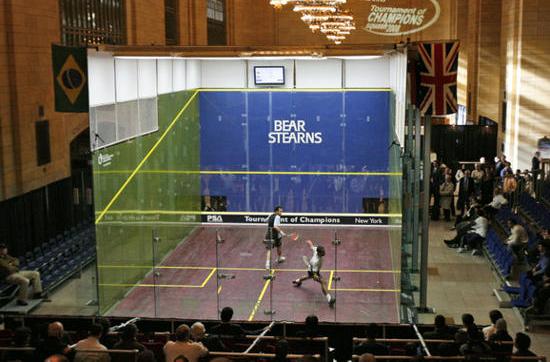
Squash At Grand Central


How do you make one of the Professional Squash Association's most significant events more attractive to spectators? Bring it to the masses. The J.P. Morgan Tournament of Champions is annually held at New York City's Grand Central Terminal in a specially constructed four-walled glass court inside Vanderbilt Hall.

King Of Grass vs. King Of Clay


The above image is not a trick. Tennis stars Roger Federer and Rafael Nadal really did play a 2007 exhibition match in Mallorca, Spain, on a customized half-clay, half-grass court designed to determine which of the two players was the best all-surface player. Nadal won a tightly contested three-set match much to the delight of the Spanish fans in the crowd.

The WNBA Takes Center Stage


Kicked out of Madison Square Garden as a result of the 2004 Republican National Convention, the New York Liberty seized the opportunity to find a new venue that would bring some rare mainstream attention to the WNBA. They hosted the Detroit Shock at historic Radio City Music Hall, a venue that was especially unusual because seating there allowed fans to watch the game from only one side of the court.

Two Teams, One End Zone


A football game between Northwestern and Illinois at Wrigley Field seemed like a natural fit in 2010, but organizers failed to take into account the lack of space between the back of one end zone and the ivy-covered outfield wall. As a result, only the other end zone could be used for offense due to safety concerns, an embarrassing gaffe for the Big Ten but one that also made the game memorable.

The Boys Of Winter


The popularity of hockey in outdoor football stadiums has steadily increased since Spartan Stadium hosted Michigan and Michigan State in 2001, but the signature event has become the NHL's Winter Classic held annually on New Year's Day. And no Winter Classic has piqued the interest of fans quite as much as the sight of the Philadelphia Flyers and Boston Bruins squaring off on the field and famed Fenway Park in 2010. Bruins fans went home satisfied: Their team won 2-1 in overtime.

Golf On Glaciers


Golf is hard enough in picturesque 70-degree weather, so imagine how much more difficult it is when you introduce arctic conditions. That's the challenge each March in Greenland at the World Ice Golf Championships, which is played with a fluorescent orange ball and with glaciers and icebergs replacing sand traps and water as hazards.

The Carrier Classic


Michigan State and North Carolina will pay tribute to the military by playing a basketball game on an aircraft carrier on Veteran's Day in San Diego. The two teams will don camouflage jerseys with U.S.A. on the back of them, and President Obama and thousands of military personnel will be in the audience. If it's sunny out, the game will take place on the flight deck. If not, it will move a level below into the air plane hangar.

The Great Wall Marathon


Hitting the wall isn't just a figure of speech at this grueling annual marathon. A quarter of the scenic 26.2-mile route takes place on China's famed Great Wall itself, and every runner must ascend about 3,800 stone steps to reach the finish line. The course record belongs to Spaniard Salvador Calvo, who won the 2007 race in 3 hours, 23 minutes, 10 seconds.


Tennis On a Helipad


The most memorable points Andre Agassi and Roger Federer ever played against one another didn't come at Wimbledon, the U.S. Open or any other Grand Slam. None of that compared to the sight of the two tennis superstars trading ground strokes 700 feet above Dubai's Jumeirah beach in a February 2005 exhibition on the helipad on the roof of the seven-star Burj Al Arab hotel.

Source: Yahoo.com

Famous People Named Adolf

Adolf will always be associated primarily with the Third Reich Führer. That is also the reason for the decreasing popularity of this, once wide-spread, name after WWII. Nevertheless, there were a lot of well-known personalities named Adolf.

Adolf Dassler
1900 – 1978


Adolf Dassler, more known as Adi Dassler, was always a passionate sportsman. Born into the family of a German shoe worker, Adi became a cobbler himself, but he had a dream to create a shoe specifically for athletes. Shortly after WWI, he started to work on it in his mother’s laundry room, assisted by his brothers (the older one, Rudolf, will be later known as the founder of Puma). The brothers soon started a successful business, which was called Gebrüder Dassler Schuhfabrik (Dassler Brothers Shoe Factory). Dassler didn’t miss any sporting event in his quest to make athletes wear the shoes from the Dassler Shoe Factory. At the 1928 Olympics in Amsterdam, some athletes were wearing these shoes and, during the 1936 Summer Olympics in Berlin, the US athlete Jesse Owens won 4 gold medals wearing Dassler’s shoes. All that was a good advertisement for the company and helped it to establish international contacts.

As WWII began, Adi’s brother Rudolf was drafted. Adi himself produced boots for Wehrmacht (undoubtedly helped by the fact that he voluntarily joined the Nazi Party). After the war, the brothers tried to continue working together, but due to the disagreements Rudolf left Adi and founded his own company, Puma. Adolf Dassler reformed his shoe company and gave it a new name using the short form of his first name and the first three letters of his last name. Adidas is one of the most well-known sportswear companies.

Adolph von Menzel
1815-1905


Adolph von Menzel is one of the most renowned German artists. He was considered the most successful artist in Germany in the 19th century. In 1833, Menzel studied for a short period of time at the Berlin Academy of Art. He drew from casts and ancient sculptures. But generally, Menzel was self-taught.

Menzel was the first to largely introduce to Germany the technique of wood engraving. From 1839 to 1842, he produced 400 drawings, illustrating the Geschichte Friedrichs des Grossen (History of Frederick the Great) by Franz Kugler. After that, he brought out Friedrichs der Grossen Armee in ihrer Uniformirung (The Uniforms of the Army under Frederick the Great), Soldaten Friedrichs der Grossen (The Soldiers of Frederick the Great); and finally, following the order of the king Frederick William IV, he illustrated the works of Frederick the Great, Illustrationen zu den Werken Friedrichs des Grossen (1843-1849). These works established Menzel’s claim to be considered one of the first illustrators of his day.

His popularity in Germany, especially due to his politically propagandistic works, was so great that most of his major paintings remained in Germany, as a lot of them were quickly acquired by Berlin museums. Menzel himself traveled a lot searching for subjects for his art, visiting exhibitions and meeting with other artists, but still spent most of his life in Berlin. Although he had many friends and acquaintances, he was, by his own words, detached from others. He probably felt socially estranged for physical reasons, alone—Menzel was about four foot six inches and had a large head.

Adolph Freiherr Knigge
1752-1796


During his life, the German writer and Freemason Adolph Freiherr Knigge (Freiherr is not a personal name but a title, meaning Baron) was a member of Corps Hannovera, the Court Squire and Assessor of the War and Domains Exchequer in Kassel, Chamberlain at the Weimar court and a member of Bavarian Illuminati.

Still he’s mostly remembered for one book he wrote. This book should be known by any German. Knigge’s Über den Umgang mit Menschen (On Human Relations) is a fundamental sociological and philosophical work on principles of human relations and also a guide to behavior, politeness and etiquette. There even appeared the word Knigge in German language to mean “good manners” or books on etiquette.

Adolf Anderssen
1818 – 1879


In the 1850′s and 1860′s, the German chess master Adolf Anderssen was considered to be the strongest chess player. He took the first prize in over half of the European tournaments, from 1851 to early 1878. In 1851, he represented Germany in the first international chess tournament, which took place in London. The tournament made Anderssen the world’s leading chess player. A month later the London Chess Club organized a tournament which included several players who had competed in the International Tournament. Anderssen won again. During his career Anderssen also knew defeat. He didn’t do as well in matches as in tournaments. In 1866, Anderssen lost a close match with Wilhelm Steinitz. At the Leipzig tournament in 1877, Anderssen came second, behind Louis Paulsen. The tournament was organized on the initiative from the Central German Chess Federation, to commemorate the 50th anniversary of Anderssen’s learning the chess moves. Remarkably, it was the only tournament ever organized to commemorate a competitor.

All in all, Anderssen was a very important figure in the development of chess problems. He is known for his brilliant sacrificial attacking play, particularly in the “Immortal Game” (1851) and the “Evergreen Game” (1852). Adolf Anderssen was honored to be an “elder statesman” of the game, to whom others turned for advice or arbitration.

Adolf Bastian
1826-1905


Adolf Bastian was a major ethnologist of the 19th century, who contributed greatly to the development of such disciplines as ethnography and anthropology. His theory of the Elementargedanke became a basis for Carl Jung’s theory of archetypes.

Bastian’s career at university was very broad. He first studied law at the Ruprecht Karl University of Heidelberg, and biology at what is today the Humboldt University of Berlin, the Friedrich Schiller University of Jena and the University of Würzburg. There he attended lectures by Rudolf Virchow and became interested in what we now know as ‘ethnology’. He eventually earned a degree in medicine, in Prague in 1850. Bastian worked as a ship’s doctor and for 8 years he traveled around the world. It was his first travel spent outside the German Confederation. Having returned home in 1859, he wrote a popular account of his travels and an ambitious three volume work, Man in History, which became one of his most well-known works.

In 1861, he went on a four-year trip to Southeast Asia, which led to the six volume work entitled The People of East Asia. For the next eight years, Bastian stayed in the North German Confederation, where he was involved in the creation of several key ethnological institutions, in Berlin. He made copious contributions to Berlin’s Royal museum and the second museum, the Museum of Folkart, was founded largely thanks to Bastians contributions. Its collection of ethnographic artifacts became one of the largest in the world for that time, and for decades to come. He also worked with Rudolf Virchow to organize the Ethnological Society of Berlin. During this period, he was the head of the Royal Geographical Society of Germany. Since the 1870s, Bastian was traveling extensively in Africa as well as the New World. He died during one of his journeys, in Port of Spain, Trinidad and Tobago.

Adolf Hurwitz
1859-1919


A Jewish-born German mathematician, Adolf Hurwitz was described by Jean-Pierre Serre as “one of the most important figures in mathematics in the second half of the nineteenth century”. He was taught mathematics by Hermann Schubert, who found out his talent for mathematics and persuaded Hurwitz’s father to allow Adolf to go to university. He also arranged for Hurwitz to study with Felix Klein at Munich. Under Klein’s direction, Hurwitz became a doctoral student. His dissertation, in 1881, concerned elliptic modular functions. After working for two years at the University of Göttingen, and being an Extraordinary Professor at the Albertus Universität in Königsberg, Hurwitz took a chair at the Eidgenössische Polytechnikum Zürich, in 1892, and remained there for the rest of his life. Among his students there was Albert Einstein.

Hurwitz was one of the early masters of the Riemann surface theory and one of the authors of Riemann–Hurwitz formula. Hurwitz was particularly interested in number theory. He studied the maximal order theory for the quaternions. In number theory, there’s a Hurwitz theorem named for him.

Adolf Eugen Fick
1829 -1901 and 1852-1937


The seventh place is shared by the German physiologist Adolf Fick and his ophthalmologist nephew of the same name.

The first started to study mathematics and physics, but then realized he was more interested in medicine. In 1851, he earned his doctorate in medicine at Marburg. After that he worked as a prosector in anatomy. In 1855, Fick’s law of diffusion was introduced. The law, which applies equally to physiology and physics, governs the diffusion of a gas across a fluid membrane. Fifteen years later, Adolf Fick introduced a technique for measuring cardiac output, called the Fick principle. Fick is also known as an inventor of the tonometer. This work influenced his nephew, who invented the contact lens.

Adolf Gaston Eugen Fick was actually raised in the family of his uncle after the premature death of his father, anatomy professor Ludwig Fick. He studied medicine in Würzburg, Zürich, Marburg und Freiburg. In 1887, he tested an afocal scleral contact shell, made from heavy brown glass, on rabbits then on himself and, finally, on a small group of volunteers. It was considered the first successful model of a contact lens. During WWI, Fick headed the field hospitals in France, Russia and Turkey. At the same time he continued working on ophthalmologic anatomy and optics.

Adolf Merckle
1934-2009


Adolf Merckle, a German billionaire, became one of the victims of financial crisis. In 2009, he committed suicide by throwing himself in front of a train.

Merckle owned the largest pharmaceutical wholesaler in Germany, Phoenix Pharmahandel. He inherited his business from a grandfather but contributed greatly to its development. In 2006, Merckle was the world’s 44th richest man. He faced problems in 2008, during the financial crisis when he made a speculative investment based on his belief that Volkswagen shares would fall. However, in October 2008, Porsche SE’s support of Volkswagen sent shares on the Xetra dax from €210.85 to over €1000 in less than two days, resulting in losses estimated in the hundreds of millions of dollars for Merckle.

“The desperate situation of his companies caused by the financial crisis, the uncertainties of the last few weeks and his powerlessness to act, have broken the passionate family entrepreneur and he took his own life,” a family statement said.

Adolf Loos
1870-1933


German architect Adolf Loos was born in Brunn, Czechoslovakia, in 1870. He started studying architecture at the Royal and Imperial State Technical College in Rechenberg, Bohemia, but soon was drafted to the army, where he served for two years. He then attended the College of Technology in Dresden for three years. From 1893 to 1896, he lived in the U.S. and worked as a mason, a floor-layer and a dish-washer. He finally got a job with the architect Carl Mayreder and, in 1897, he already had his own practice. He taught for several years throughout Europe, but returned to practice in Vienna, in 1928.

Adolf Loos had great influence in European Modern architecture. Still, he was more known for his writings rather than for his buildings. In his essay Ornament and Crime, he repudiated the florid style of the Vienna Secession, the Austrian version of Art Nouveau. This, and many other essays, are devoted to the elaboration of a body of theory and criticism of Modernism in architecture. Loos established building method supported by reason, as he was convinced that everything that could not be justified on rational grounds was superfluous, and should not exist. Loos preferred pure forms due to economy and effectiveness. He was also against decoration, considering it mass-produced and mass-consumed trash, and believing that culture resulted from the renunciation of passions, thus the absence of ornamentation generated spiritual power. His fight for freedom from the decorative styles of the nineteenth century inspired future architects.

The buildings by Adolf Loos are mostly situated in Vienna, but can also be found in Paris, Prague and other cities.

Adolf von Henselt
1814 – 1889


Adolf von Henselt was a German composer and pianist, born at Schwabach, Bavaria. He began to learn the violin at the age of three and the piano at five. As he got a financial help from King Ludwig I of Bavaria, he went to study under Johann Nepomuk Hummel in Weimar for some months, and then moved to Vienna in 1832, where, along with studying composition, he made a great success as a concert pianist. Several years later he moved to Saint Petersburg, and became court pianist and inspector of musical studies in the Imperial Institute of Female Education, and was ennobled in 1876. For summer holidays he usually went to his former homeland, Germany. In 1852 and again in 1867, he visited England, though in the latter year he made no public appearance. He actually had to withdraw from concert appearances by age thirty-three because of a stage fright so bad it was close to paranoia.

Henselt’s playing can be characterized as a combination of Franz Liszt’s sonority with Hummel’s smoothness. It was remarkable for the great use of extended chords and for the perfect technique. Henselt had an immense influence on the next generation of Russian pianists. The entire Russian school of music comes from Henselt’s playing and teaching. A famous Russian composer, Sergei Rachmaninoff, had a very high opinion of Henselt, and considered him one of his most important influences.

Saturday, November 12, 2011

Most Dangerous Sports

The following list shows places where modern sport has devolved into novel death wishes.

Cave Diving


The idea for this sport came as somebody was disposing of a body. Take all the regular hazards of diving (itself a dangerous activity), and add exploring uncharted territory, freezing temperatures, low-visibility conditions, and cramped quarters. And don’t forget that ticking clock on your air supply—you can’t just go “up” to breathe (risking “the bends”). On top of that, it’s still a wilderness experience, and some of the caves actually have wild animals living in them. According to a recovery team based in San Marcos, there have been more than 500 deaths from this sport since the 1960s. The risks are so high that experience affords little protection– many of these victims have been diving instructors and technical divers. As a result, the National Speleological Society defines a “successful” cave dive as “one you return from.” Perhaps they should follow that logic and define an “intelligent” cave dive as “one you don’t take”.

BASE Jumping


You know, we used to call this behavior “attempted suicide”. BASE jumpers willingly hurl themselves from Buildings, Antenna, Spans, or Earth with nothing but a hand-deployed parachute to prevent “deceleration trauma.” In this game, there’s no need to keep score: the winner is the one who DOESN’T DIE. Lucky losers get slammed back into the object they just jumped off of or break everything they have made of, say, bone. Between 5 and 15 people die each year, according to Harry Parker of The International PRO BASE Circuit. This is sport is illegal almost everywhere, and with good reason. R.I.P. Slim.

High Altitude Climbing


Let’s see: a sport that keeps fatality stats and has NO chance of women in bikinis. Nope, I’ll just buy the $945 North Face jacket and read “Into Thin Air”, thank you. Today, about one death occurs for every six successful summits on Everest, and each victim had to pass corpses on the way up. Real mountaineers face every threat you can imagine, up to and including drowning. Gravity must queue up for its chance to kill you, as hypoxia, hypothermia, frostbite and pneumonia all have prior reservations. Even a regular injury can be fatal, as rescue helicopters simply can’t get to you and your buddies may be too gassed to help. But if you do summit (you’ll probably have to wait in line), keep those glasses on or you’ll burn up your corneas from excess UV radiation. Kinda defeats the purpose, huh? To date, 179 out of 1,300 different Everest climbers have died, but mortality rates have started to decline since 1990.

Motorcycle Racing


Motorcycling is the most dangerous motorsport in the world. Just one example is The Isle of Man TT event, which has a rich 100-year history. But during that time, there have been over 220 deaths. The drivers in the race are required to maintain their balance while driving through all types of obstacles such as rocks and trees, and even bugs on their windscreens. This is all done while traveling at an extremely high rate of speed. And don’t get me started about all that X-Games crap.

Cheerleading


Forget the wimps wearing pads and helmets- the real danger is on the sidelines, where estrogen and adrenaline combine in one of the newest recognized sports. It has been estimated that there are over 20,000 reported cheerleading injuries a year, making cheerleading the most injury-prone sport in the world for women. Many common injuries include broken legs and spinal injuries. Think about it—it’s like diving on land, with easily distracted co-eds serving as the water. I’m all for cute girls in skimpy outfits, but this sport has a lot of catching up to do, safety-wise.

Bull Running


The Running of the Bulls (“encierro”) is a “sport” that involves running in front of bulls that have been let loose on a course of a town’s streets. There are actually several encierros, but the most famous is in Pamplona, Spain, and it was mentioned in Hemingway’s “The Sun Also Rises” and “Death in the Afternoon”. The purpose is to entice or herd the bulls from off-site corrals to the bullring. Any fool over eighteen with more bravado than brains (which would have included me at eighteen) can participate. Every year between 200 and 300 people are injured, mostly with contusions due to falls. Since 1910, 14 people have been killed in Pamplona’s Running of The Bulls.

Bull Riding


Rodeo started as the gymnastics of ranching: a series of highly specific competitions taken from key aspects of cattle ranching in the Old West. But there never was and never will be any damn reason to ride a bull: its only practical application is to make you appreciate your own job—even if you’re unemployed. Straddling 1800 pounds of leaping pissed-off beef (an effect achieved by constricting bovine genitals with rope, or TASERING) routinely results in the rider being thrown 10 feet into the air, with a landing cushioned by a mere inch of dirt and feces. And if you don’t break your jaw, ribs, or collarbone on re-entry, you still have that bull to worry about (he’s still bitter).

Big-Wave Surfing


Let’s not get crazy here: nobody’s saying surfing isn’t fun and or that it isn’t a great excuse to get chicks in bikinis. But any sport with rules for when a shark enters the field of play is not for those with functioning frontal lobes. Big Wave Surfing cranks the dial to 11 by towing surfers into monster 50 ft waves strong enough to crush villages. So if the brute force of the wave doesn’t kill you or bury you so far underwater that you drown, you could still bash your head on submerged rocks or fail to avoid your own board (fickle thing!) hurtling past you like a Randy Johnson fastball.

Heli-Skiing


There’s a reason some things are so inaccessible—it’s God’s way of saying, “Don’t be stupid”. Still, people pay top dollar to be helicoptered (at $500 a pop) to untouched snowcaps, where they leap onto virgin slopes and ski far from crowds but very close to avalanches. Even the helicopter ride can be dangerous, and many have died en route to untouched powder (Frank Wells, former president of The Walt Disney Co. died in a helicopter crash during a heli-skiing trip in 1994).

Street Luging


Climb a big hill on an open-for-business highway, lie supine on an elongated skateboard and roll down. Gather speed and try not to die. That’s going to be difficult because you have no brakes, you’re an inch from a road surface itching to see what bone marrow looks like, and you present a visual profile to passing vehicles that’s only slightly larger than a puddle. Which is what you’ll be if you have anything close to a lapse in concentration or luck.

Strange Jobs From History

Most of these jobs are no longer in existence so we can but look back and wonder what it must have been like to have been employed in these weird jobs.

Water Organist


The hydraulis was a type of pipe organ blown by air, where the power source pushing the air is derived by water from a natural source (e.g. by a waterfall) or by a manual pump. Consequently, the water organ lacked a bellows, blower, or compressor. The instrument was extremely popular in ancient Rome and there were regular competitions for it. At one competition, a player named Antipatros won a prize for playing the instrument for two days straight. A water organist was guaranteed a long career as the instrument was used at all holidays, and social events. Even emperor Nero played the hydraulis. Another benefit to the job was that you got the best seats in the house at the gladiators events because the organ was used to accompany the fights.

Slinger


A slinger was a man trained to use the sling. The sling was an essential part of roman military strategy because it was more effective (both in distance and damage) to an arrow. As a child, slingers-in-training would be required to kill their dinner – no kill, no food. It was an extremely good way to get youths trained fast. The slinger could throw stones up to one pound in weight and they could be used accurately up to 200 meters.

Funeral Clown


The funeral clown was paid to dress up as the dead person, wear a mask of his face, and dance about acting like him. The Romans believed that this would placate the spirits of the dead and bring joy to the living. As the funeral processed, the funeral clown would run alongside the corpse with other clowns making jokes and mimicking the dead. Some clowns were very highly regarded and even got to mock the emperor at his funeral. They were well paid and an oddly happy diversion from the clowns regular job as the head of a mime troupe.

Orgy Planner


The orgy planner had a very unusual but very exciting job – he got to plan festivities for the rich of society and, in some cases, got many perks (which I am sure you can imagine without me spelling it out). The orgy planner had to organize food, women, music, and accommodation. The downside to the job is that the orgy planner was not liked by all members of society (particularly those who were never invited to orgies) and the trade was even banned for a short time. The most famous orgy planner was Gaius Petronius who is most famous for writing the satirical book about Roman debauchery called Satyricon.

Curse Tablet Maker


Curse tablets were thin sheets of soft lead which had curses written on them. The curses were then affixed by nails to the altars or walls of temples. The poor curse tablet writer had sit day in and day out hearing the complaints and woes of his customers who needed curses written. Fortunately many of these curse tablets have survived to modern times so we can get a glimpse of life and the way thinking of the Romans. Here is one example: “bind every limb and sinew of Victorius, the charioteer for the Blue team.. the horses he is about to race… blind their eyes so they cannot see and twist their soul and heart so they cannot breathe.”

Gymnasiarch


The gymnasiarch had a busy job in ancient Greece due to the popularity of athletics. Despite being a dirty job – the gymnasiarch had to oil and scrape the athletes as well as tidy up after wrestling matches and the gymnasium in general, the position was highly sought after by the rich as it was considered the epitome of philanthropic occupations. To qualify as gymnasiarch you had to be between 30 and 60 and you have a large net worth. One benefit of the job was that you got to carry a stick with which to beat sullen youths who misbehaved in the gym.

Litter Carrier


The litter carrier was a slave whose job it was to cart women (and later men) around in little carriages. It was a hard job and a tedious one and could be dangerous (picture carrying a carriage up a flight of stairs!) The litter carriers were usually dressed in fine garments and the litters became more and more extravagant over the years. In fact, in later years many wealthy romans had windows of glass in their litters instead of the traditional curtains. Documents from the Roman times tell us that it was very uncomfortable to travel by litter as it could make one sea sick. This job has remained to a certain extent in that there is a group of men trained to carry the Papal Sedia Gestatoria (a throne carried on men’s shoulders). The sedia was last used in the 1980s but may make a come back due to recent security complications surrounding Pope Benedict XVI.

Urinatores


The urinatores were salvage divers from Ostia. The name – with its similarity to urine – is probably a reference to the fact that the deep diving caused so much pressure on their abdomens that they urinated a lot. The divers had but one tool – a kettle shaped diving bell filled with air for breathing and weighed down with lead weights – to help the divers reach up to 30 meters below the surface. Their job was primarily salvage but they also moved construction equipment around. The dangers in this job are obvious but the pay was good – with many of the divers becoming very affluent members of Roman society.

Stercorarius


Rome was famous for its extensive sewer system. But despite having such an advanced method of dealing with poop, most Roman’s didn’t have access to it (either because they lived on the hills, or were too poor for plumbing). And sometimes even those who could afford it, didn’t want it due to the smells that would leak into people’s homes and the rats and other vermin that lived in the sewers. This meant that most houses needed to deal with their poop in some other way. This is where the stercorarius comes in. He would travel door to door collecting all the human waste and cart it off to the edge of town. Farmers would buy the dung for their crops, so effectively the Romans had a better way of dealing with their waste than we do in modern times.

Silver Miner


This is not so much strange as it is downright dangerous and dirty. Not having tools strong enough to do the job without labor, the ancients had to mine everything by hand; and those hands were usually the small hands of children. Life expectancy in the silver mines was 3 months – but that didn’t bother the Romans because it was slaves that did the work. Young boys would be pushed down very small holes that were extraordinarily deep considering they were dug manually. The holes were hot and stuffy and prone to collapse. Outside the mines the silver ore was smelted down, producing poisonous gasses. Needless to say, this added to the danger of the job.